


How a consistent content structure, relational data and intelligent search functionality laid the foundation for a scalable research platform.
As organisations grow, their content tends to grow with them. New publications are added, research projects evolve, researchers join and leave, podcasts are published and events are organised. Individually, everything still makes sense. Over time, however, valuable information often becomes scattered across different sections of a website, making it harder to manage, discover and reuse.
That was one of the key challenges within a recent project for Foundation for Auditing Research (FAR).
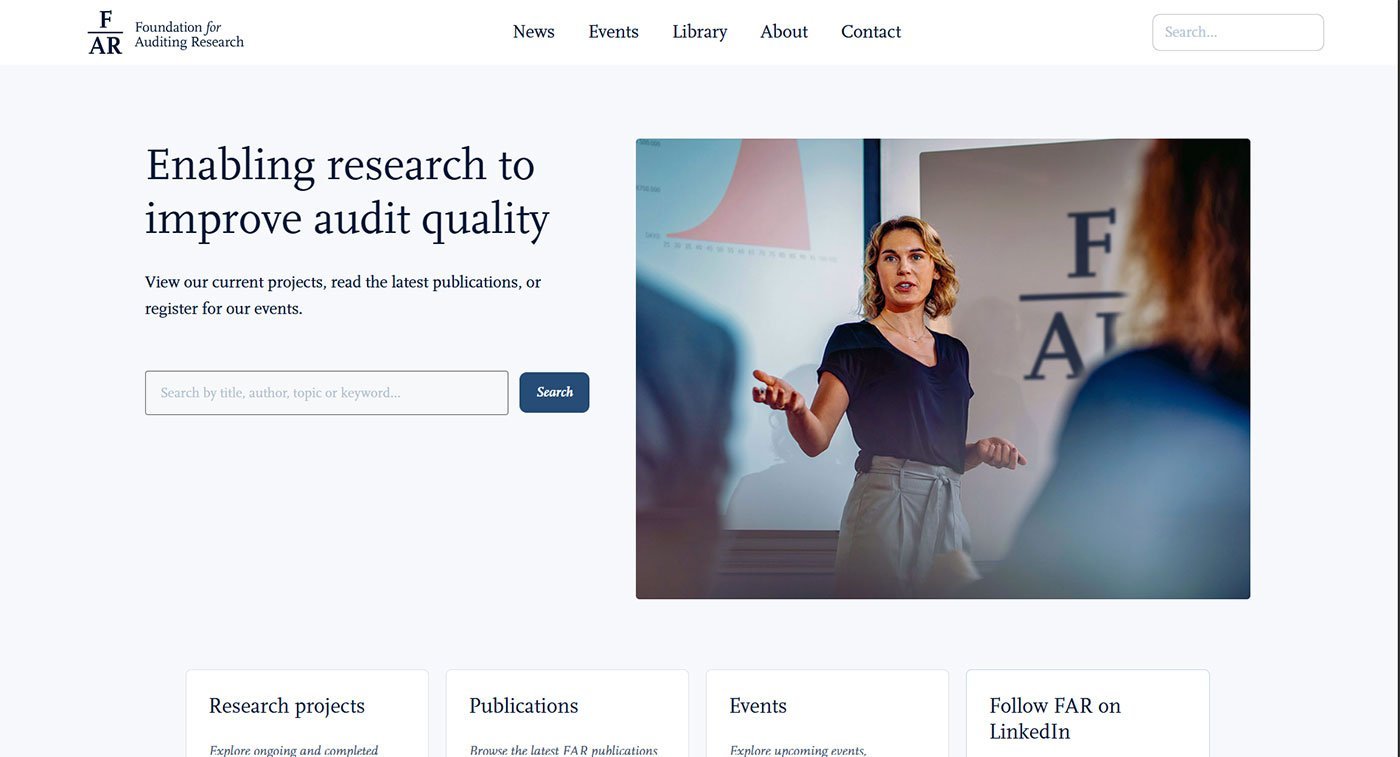
FAR manages a substantial collection of research-related content, including publications, research projects, researchers, universities, podcasts, news articles and events. While all of this content was valuable, there was an opportunity to improve how these different content types connected and supported each other.
The goal was therefore not simply to redesign pages, but to create a stronger foundation that would improve discoverability, simplify content management and provide a better user experience.
The Challenge: Valuable Content Without Clear Structure
Many websites evolve organically. New sections are added when needed, new content types are introduced and additional functionality is layered on over time.
While this approach often works in the short term, it can eventually create challenges:
- content is entered inconsistently;
- information becomes scattered across multiple sections;
- visitors struggle to find relevant resources;
- search results become less relevant;
- future development becomes increasingly complex;
- search engines receive limited context about relationships between content.
The result is a website that contains valuable knowledge but does not always make that knowledge easy to discover.
Building the Right Foundation First
Before design improvements or new functionality can have a lasting impact, the underlying data structure needs to be solid.
For that reason, a significant part of this project focused on the content architecture behind the scenes.
A consistent structure was introduced for publications, projects, researchers, events, podcasts and universities. Each content type received its own logical set of fields and relationships.
More importantly, these content types were connected to one another.
A publication can be linked to multiple researchers. Researchers can be connected to universities. Projects can relate to publications, researchers and events.
Together, these relationships create what is effectively a relational knowledge database within WordPress.
Although this sounds technical, the practical benefits are significant.
Less Freedom, More Clarity
One common mistake in content management is providing editors with too much freedom.
While flexibility may sound attractive, it often leads to inconsistent data entry. Important metadata is forgotten, content is formatted differently and relationships between information become difficult to maintain.
This project deliberately moved in the opposite direction.
Instead of relying on large free-text areas, editors were provided with clear and focused input fields designed for specific information.
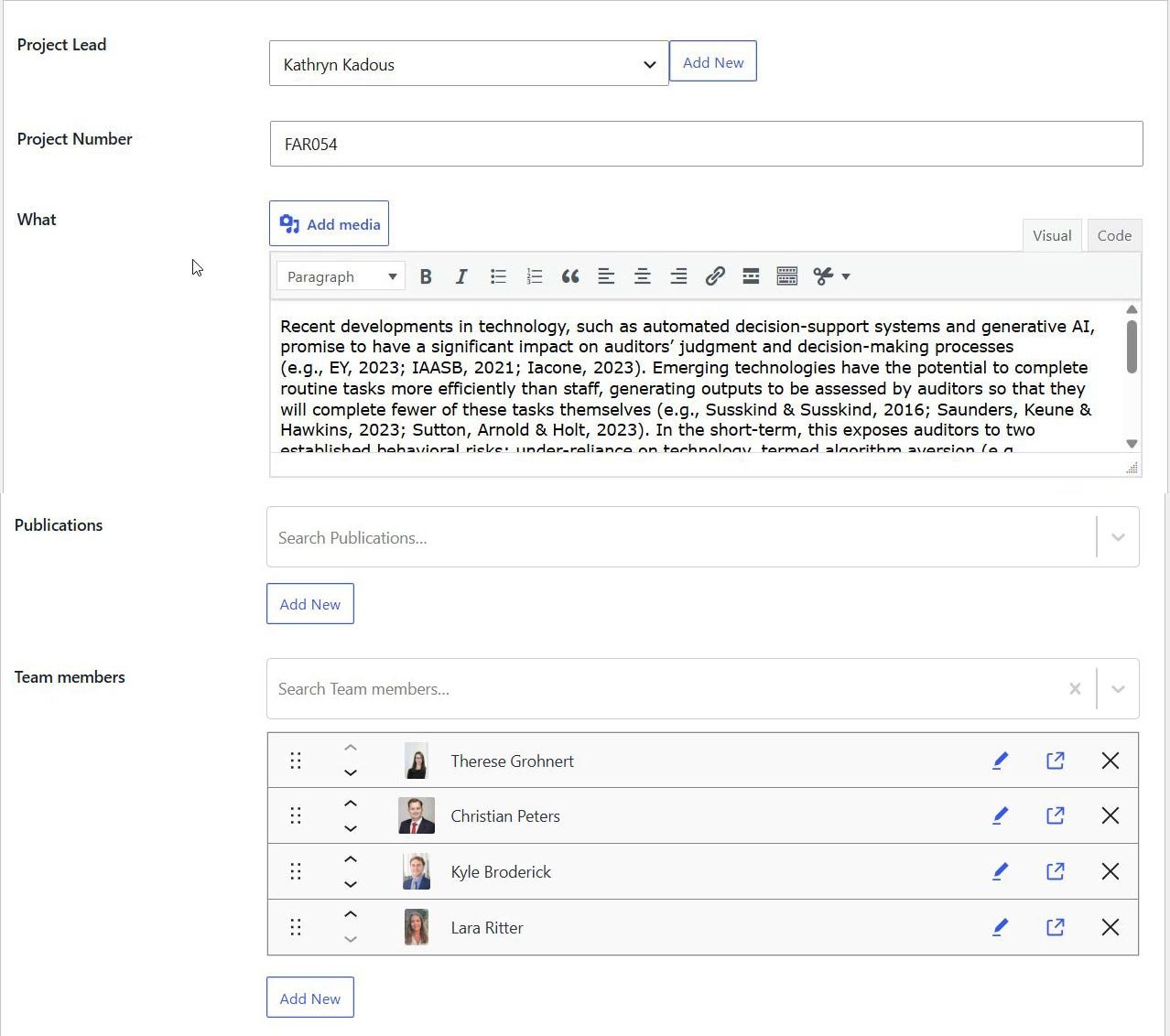
The result is faster content entry, more consistency and fewer mistakes.
Editors benefit from a simpler workflow, visitors benefit from a more consistent experience and search engines benefit from better structured data.
Why Structure Matters for SEO
Modern SEO is no longer just about keywords.
Search engines increasingly focus on understanding topics, entities and relationships between pieces of content.
When publications are linked to researchers, universities, projects and research themes, search engines gain a much clearer understanding of context and relevance.
This creates several important advantages:
- consistent metadata;
- stronger internal linking structures;
- reduced duplication;
- clearer topical relationships;
- improved indexability;
- greater flexibility for future growth.
In many cases, effective SEO starts with a well-designed content model rather than traditional content optimisation.
A Central Knowledge Library
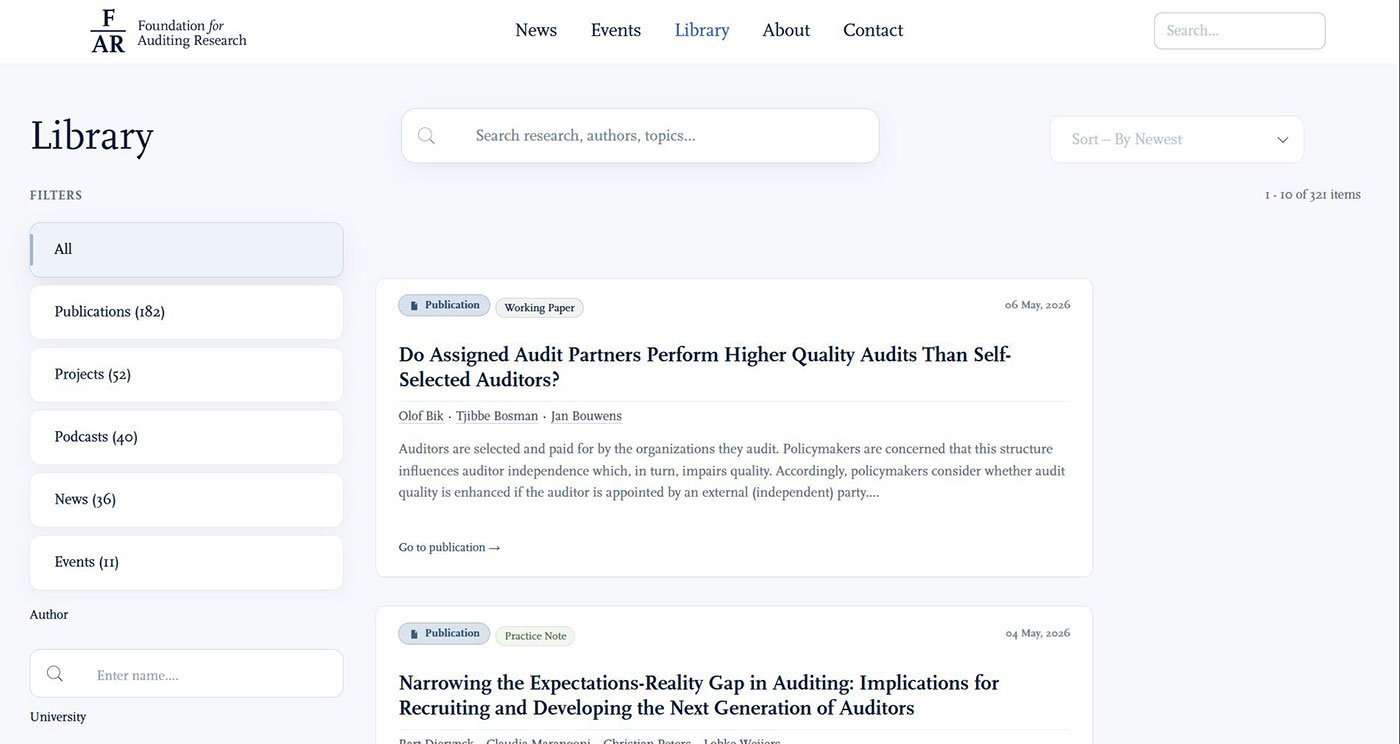
One of the primary goals of the project was to make information easier to discover.
To achieve this, content was brought together within a central knowledge library where visitors can search, browse and filter across publications, projects, researchers, podcasts, events and news content.
This creates a single entry point for knowledge discovery without requiring visitors to understand how the website is organised internally.
The LEGO Effect of Structured Data
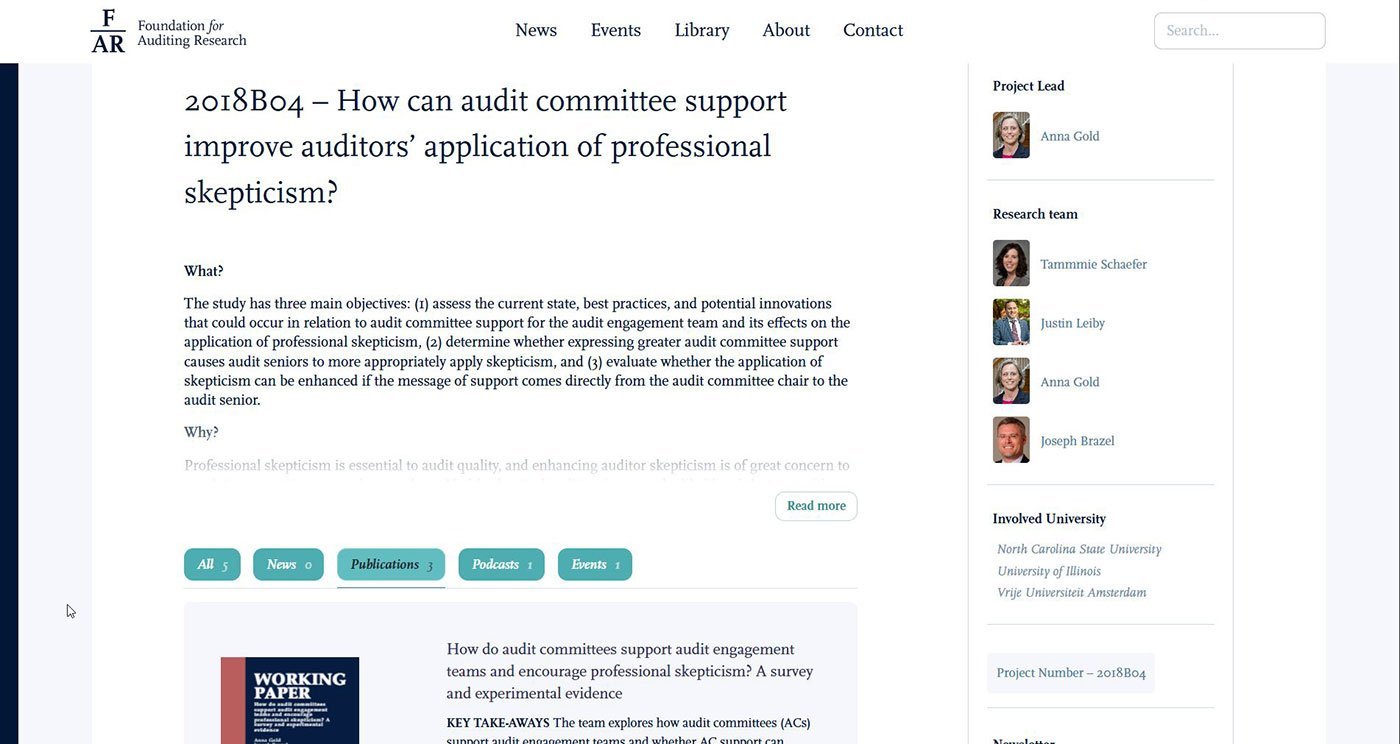
One of the greatest advantages of a consistent content architecture is reusability.
When content follows a structured model, the same data can be reused across many different areas of a website.
This becomes visible on project pages, researcher profiles, search results, content overviews and homepage components.
Content only needs to be entered once and can then be automatically displayed wherever it is relevant.
This dramatically improves scalability and long-term maintainability.
The Ecosystem Effect of Connected Content
One of the greatest advantages of a relational content model is that individual sections of a website no longer operate in isolation.
Publications can be connected to researchers. Researchers can be linked to universities. Projects can reference publications, researchers and events. News articles can highlight ongoing research initiatives and the experts involved.
The result is not simply a collection of pages, but a connected ecosystem in which content continuously reinforces and enriches other content.
For visitors, this creates a more intuitive discovery experience. For content editors, it reduces duplication and maintenance effort. For search engines, it provides clearer signals about relationships, expertise and topical relevance.
The homepage, project pages, researcher profiles, search results and content overviews all draw from the same underlying structure. Content only needs to be entered once to create value across multiple areas of the platform.
Search Functionality as an Extension of Structure
Good search functionality begins long before a visitor enters a search term.
Search systems can only deliver relevant results when content is properly organised and indexed.
By improving the underlying structure of content types, metadata and relationships, search becomes more accurate, useful and aligned with visitor intent.
Search therefore becomes a natural extension of the knowledge platform rather than an isolated feature.
Building for the Future
A well-designed content architecture does more than solve today's challenges. It creates a foundation for future growth.
Because content types, metadata and relationships are structured consistently, new functionality can be introduced without redesigning the entire platform.
Additional filters, new content overviews, advanced search capabilities, reporting dashboards or future integrations can all build upon the same underlying data model.
This approach reduces technical debt and ensures that the platform can continue to evolve alongside the organisation's needs.
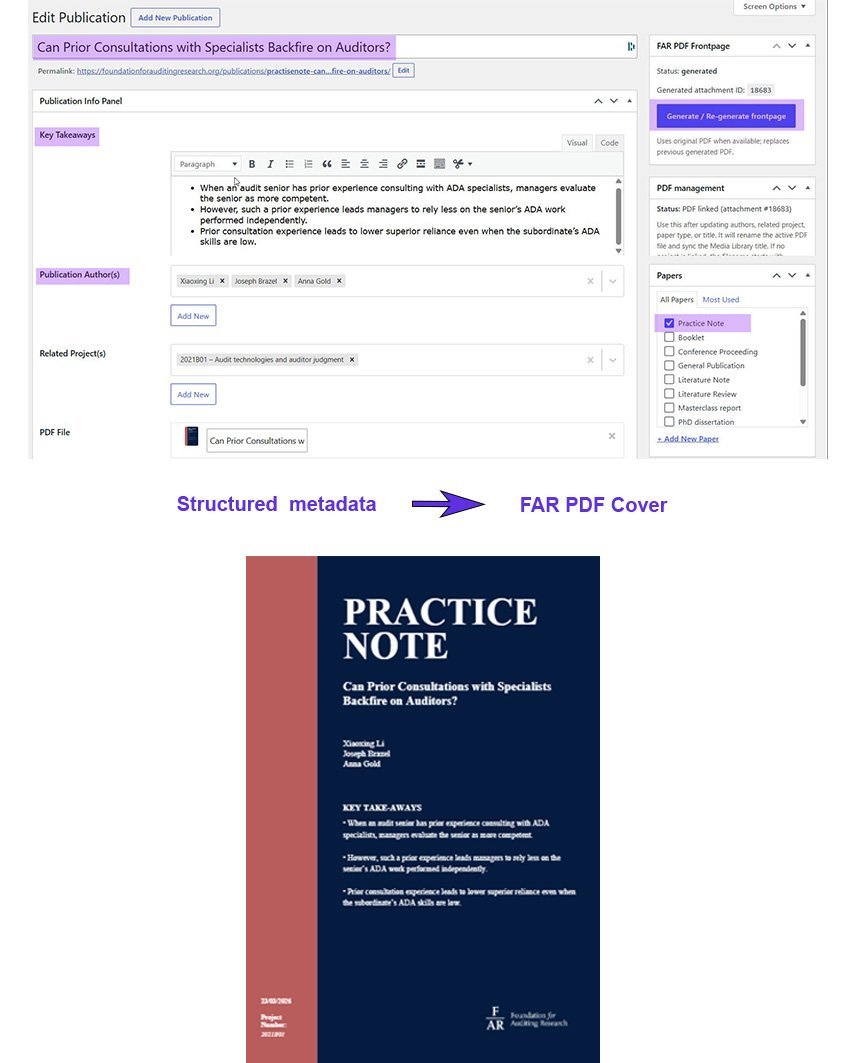
Automated Publication Covers
A further challenge involved maintaining a consistent visual identity across hundreds of research publications.
Instead of manually designing individual cover pages, a custom PDF generation workflow was developed that automatically creates FAR-branded publication covers using metadata stored within the content model.
Titles, authors, publication types and other structured information are pulled directly from the database and incorporated into a standardised cover design.
This ensures visual consistency, reduces manual work and guarantees that publication metadata remains synchronised across the website and downloadable documents.
Technology Serving Content
The technical implementation was built on WordPress, supported by specialised tools for content modelling, search functionality and dynamic content presentation.
More important than the individual tools themselves was the way they worked together to support the overall content strategy.
The Result
- better understood by search engines;
- easier to manage for content editors;
- scalable for future growth;
- faster access to relevant information;
- improved use of existing content assets.
The combination of content architecture, usability, search optimisation and technical implementation is what makes projects like this particularly rewarding.
Collaboration
This project was developed in close collaboration with Bastiaan Preseun, Marketing and Communications Manager of the Foundation for Auditing Research. His focus on knowledge sharing, discoverability and user engagement helped shape many of the strategic decisions behind the platform's evolution.
Combining subject-matter expertise from the FAR team with a structured technical approach made it possible to create a platform that serves researchers, practitioners and visitors alike.
Final Thoughts
The most valuable improvements are often invisible to visitors.
Visitors see a clean homepage, intuitive project pages and useful search results.
Behind those experiences sits a carefully structured framework of content, relationships and metadata that allows everything to work together.
When that foundation is in place, a website becomes more than a collection of pages. It becomes a platform capable of growing alongside the organisation while making knowledge easier to discover and use.
Projects like this combine content architecture, technical SEO, WordPress development and user experience design.
Technologies Used
Platform & CMS
Content Modelling & Relationships
- Pods Framework
- Custom Post Types
- Relational Content Architecture
- Metadata Modelling
Search & Discoverability
- SearchWP
- WP Grid Builder
- Technical SEO
Presentation & User Experience
- Dynamic Content Rendering
- Responsive Design